The RIAA Takes On AI Music Generators
In June 2024, all three major music labels – Universal, Sony, and Warner – launched coordinated lawsuits against both Suno and Udio through the Recording Industry Association of America (RIAA). [9][10] This isn’t a small dispute over a few tracks. The RIAA accused these companies of “mass infringement of copyrighted sound recordings on an almost unimaginable scale.” [9]
Here’s the genuinely alarming bit: Suno admitted to using copyrighted music for training their AI models. [11][12] They’re arguing it’s “fair use,” but that defence is far from established in this context. The potential damages? Up to $150,000 per infringed track. [13]
These cases are ongoing in US District Courts as I write this. The outcomes will likely determine the future of AI music generation.
The Settlement Pattern (Warning Signs Ahead)
By November 2025, we’re seeing a pattern emerge. Udio settled with both Universal Music Group and Warner Music, though the terms remain confidential. [14] The labels are now pivoting to a “walled garden” model – licensing their catalogues to AI companies under strict conditions.
And just to put the scale of these legal battles in perspective: in September 2025, a group of authors settled a copyright infringement case against AI company Anthropic for $1.5 billion over the use of pirated books to train AI models. [15] That’s billion with a B. The largest AI copyright settlement ever recorded.
Legal experts predict more private settlements with AI companies offering equity stakes to rights holders rather than admission of wrongdoing. [15] Translation: the big players are paying enormous sums to make these problems go away quietly.
What This Means for You
If the platforms creating AI music are admitting to training on unlicensed music, and major labels are suing for infringement with potential billion-dollar damages, where exactly does that leave content creators who innocently used that AI music?
Spoiler: potentially holding a very large, very expensive bag.
UPDATE (January 29, 2026): News has broken that illustrates just how serious the music industry is about AI copyright. Universal Music Group, Concord, and ABKCO have filed what could be “the single largest non-class action copyright case in US history” – suing an AI company for over $3 billion over alleged infringement of more than 20,000 songs.[28]
This isn’t about AI music generators like Suno or Udio. This lawsuit targets an AI text company whose models allegedly ingested copyrighted music lyrics without permission. The complaint claims the company’s founders personally torrented 5 million pirated books (including songbooks) from notorious pirate site LibGen, despite internally describing the source as “sketchy” and a “blatant violation of copyright.”[28]
The message from the music industry couldn’t be clearer: they’re going after AI companies with unprecedented legal force, regardless of whether those companies generate music or just use music in their training data. If you’re a content creator relying on AI-generated anything that might have touched copyrighted music, you’re standing uncomfortably close to a legal battlefield measured in billions.
Since first publishing this update: the case has escalated rather than settled. The publishers filed for partial summary judgment in their original 2023 case in March 2026, arguing the evidence is no longer meaningfully contested, and amended that complaint again in July 2026 using material obtained in discovery. The separate $3bn suit heads into motion-to-dismiss briefing in August 2026. Meanwhile the $1.5 billion settlement with authors – the one I mentioned above – has now received court approval. [40] These things do not appear to be going away.
UPDATE 2 (March 19, 2026): And the tide keeps turning. Yesterday, the UK government announced it’s scrapping plans that would have allowed AI companies to train their models on copyrighted music without explicit permission.[29] The original proposal – which would have made unauthorised use of copyrighted material the default, with creators having to actively “opt-out” – sparked massive backlash from the music industry.
Of 11,520 consultation submissions, 81% named mandatory licensing as their preferred approach. Just 3% supported the government’s own “preferred” option.[30] Major artists including Elton John, Dua Lipa, Björn Ulvaeus (ABBA), Max Richter, and Thom Yorke (Radiohead) all campaigned against what Sir Elton described as “committing theft, thievery on a high scale.”[29]
UK Culture Secretary Liz Kendall confirmed the U-turn, stating that “copyright material cannot be used for AI development and training without permission.”[29] UK Music called it “a major victory for campaigners” and emphasised that the hundreds of thousands working in the industry should be able to work “without the constant fear that the fruits of their labour could effectively be taken by AI firms without payment or permission.”[29]
This marks a significant policy shift: governments are starting to side with creators over AI companies. The legal and regulatory landscape isn’t just uncertain – it’s actively moving against unlicensed AI training. Worth considering before you commit your content strategy to AI-generated music, isn’t it?
UPDATE 3 (31st July 2026): Right, this is the big one. A Munich court has just ruled that Suno infringed copyright.
Germany’s collecting society GEMA sued Suno in January 2025, arguing that the tool’s outputs were reproducing works it represents. Today Judge Elke Schwager agreed. Suno wasn’t entitled to use music from GEMA’s songwriters and composers, must disclose the revenue it earned doing so, and faces damages yet to be quantified. [31] GEMA’s chief executive called it a verdict of global significance, which is the sort of thing you’d expect a winning CEO to say, except in this instance he’s probably right. Suno disagrees with the ruling and is weighing an appeal. [32]
Two things make this bigger than a single court case.
First, it’s the first major European ruling to tell AI companies that operating without an explicit, opt-in publishing licence carries real financial consequences. [33] Not “might carry”. Does.
Second, it’s the same judge who ruled against OpenAI in November 2025 for reproducing German song lyrics. [34] Munich is quietly becoming the venue where “the model just learned patterns, it didn’t copy anything” stops working as an argument.
What it doesn’t do is settle anything in the US. A German ruling sets no precedent in Massachusetts, where Sony and Universal are still litigating against Suno. Warner settled in November 2025 and took a licensing deal instead. Sony and Universal didn’t, and in May 2026 they moved to expand the case from 560 recordings to over 61,000 – a move that would push potential statutory damages past $9 billion. [35]
So where does that leave you, sitting there with a back catalogue of AI-generated background music? Roughly where you were yesterday, but with rather less room to argue that this is all speculative hand-wringing from a bitter composer. A court has now looked at it and said: no, this was infringement.
One final twist, and it’s a strange one. In July 2026 the American Federation of Musicians sued Universal and Warner – not Suno, not Udio, but the labels themselves. [41] The union alleges that session recordings made by its members were licensed to the AI companies for training without the consent or compensation their collective bargaining agreement requires.
Sit with that for a moment. The “clean” licensed AI models – the ones built on properly negotiated deals, the ones we’re all being told represent the responsible path forward – may themselves be sitting on rights that were never actually cleared with the humans who played the notes.
Which rather illustrates the whole problem, doesn’t it? At every layer of this, somebody’s assuming somebody else did the paperwork. When you use my music, there is precisely one person in that chain, and he’s writing this sentence.



14 responses
A VERY interesting read. I (we, band members) recently used AI to produce a new version of an song we wrote and recorded back in the 80s and were blown away by how it handled it.
It was specifically instructed to adhere to the melody and lyrics and chord progressions supplied in the original upload etc, plus, our original version from the 80s was previously published on YouTube, uploaded about 15 years ago, which it can be directly compared to.
Copyright *should* not be an issue this instance.
But as regards using AI to create a song, a much different kettle of fish, as you’ve outlined.
That’s a genuinely interesting use case — and you’re right that the copyright situation there is fundamentally different. If you’re the original author, providing your own melody, lyrics, and chord progressions, and using AI essentially as a production or arrangement tool rather than a creative one, you’ve retained the human authorship that copyright law actually cares about. The fact that you have an original 1980s YouTube upload as a verifiable reference doesn’t hurt either. It’s the “type a prompt and see what pops out” approach where things get legally murky — what you’ve described is much closer to using a skilled arranger than to generating something from thin air. Sounds like it came out well, too! Shane
I write lyrics but I don’t play in a band. The most of a musical instrument I have held was a triangle at school. I have tried sending my lyrics to band/ artist. But they don’t get back to you. So when I tried an AI to do it I was impressed. So I have wrote the lyrics but the AI has done the music. I carnt copyright the song. Then the music company’s should make it easier for people to get there lyrics heard.
That’s a genuinely frustrating situation, and I think you’ve put your finger on a real problem — the traditional routes for getting lyrics in front of artists are almost entirely closed to people without connections. It’s not a reflection of the quality of the writing; it’s just how the industry is structured.
The copyright position for lyrics is actually more favourable than it is for the AI-generated music underneath them. Under current US Copyright Office guidance, lyrics written by a human can be copyrighted even if the accompanying music can’t — so your words do have protection, even if the track as a whole doesn’t. That’s worth knowing, and worth documenting properly.
On finding musicians to collaborate with, platforms like Kompoz or SoundBetter are designed specifically for exactly this kind of remote collaboration, if you haven’t tried those already.
Shane
Hi Gaz, I understand the problem . I write songs eg i have put music to help a friend who writes a bit of poetry type lyrics who didn’t mind me changing or adding on some different words to sing easier.
This may not suit you if you need to not change any words but if you don’t mind some word adjustments you are welcome to send me to view
Kind regards
Nic Rado
I’ve gone to some lengths to decipher the music AI ‘mentality’. As the creator of this blog mentioned, it’s how clever you’re capable of being. The short answer? Yes, you can ‘get away with it’. The long and safest answer is, upload your original bare-bones full composition and lyrics. The likes of Suno will polish it (make it more attractive) and may add some extra instrumental/vocals fills here and there. Use the preferred version Suno created and record the whole thing with real humans/computer/paid VST libraries, including lead singer/BV’s (the latter if needed). But before you do record, pay attention to the ‘extra fills’ that Suno included and make tweaks so it does not end up being exactly the same. It is of course safer when you are a paid subscriber. No one, not even Suno, will have a leg to stand on.
Option 2 is you use a song entirely created by Suno, or similar (but still with your own lyrics) and make such heavy changes that no one that listens to both versions will say they are exactly the same or not different enough. Many modern ‘pop’ songs have similar chord structures and there is no way any artist will sue the other for having similar chord structures.
Remember that before AI many artists copied some stuff from others. It’s the nature of things.
The workflow you’ve outlined in option one is essentially what the Copyright Office guidance points toward as the legally defensible approach — using AI as a tool to assist human creativity rather than replacing it. If you’re supplying the core composition and only using Suno to embellish or polish it, there’s a reasonable argument that the human authorship is still intact, particularly if you then re-record the whole thing with real instruments and make deliberate changes to anything AI-added.
Where I’d still urge caution is documentation. If you ever needed to defend your authorship — whether against a copyright claim or to register the work — being able to show the original composition, the Suno session, and the subsequent human modifications would be essential. “I made enough changes” is a much harder argument to win without a paper trail.
Option two is where I’d pump the brakes a bit, personally. “Heavy enough modifications that listeners can’t tell” is a subjective standard that tends to look a lot shakier when a lawyer’s involved. But you’re right that chord progressions alone aren’t protectable — it’s more about melodic and rhythmic similarity, and even that gets genuinely complicated.
Shane
Je m’amuse à faire ça aussi, ou d’utiliser le mastering et le mixage en n’oubliant jamais de décocher la case “autorise le remixage de ma musique”, (j’ai déjà retrouvé un de mes morceaux reutilisé avec un texte à la con et un arrangement très commun sur Suno, qui l’a quand même fait sauter après mon signalement) l’IA doit être utilisée comme un séquenceur, ou une station RaW complète, mais pas pour de la composition. Je crois que qu’elles commencent à évoluer par là. .. Heureusement. Sam Chökk (bandcamp, Spotify, youtube,…)
Good to hear the takedown worked — that’s unfortunately exactly the kind of thing I was alluding to in the article with the “don’t ask me how I know” line. Finding your own work turned into something with bargain-bin lyrics slapped over it is a particular kind of grim.
The sequencer analogy is spot on, and I think it’s the right frame for where this should land. Nobody argued that DAWs or sample libraries were going to kill composition — they just became part of the toolkit. The difference is those tools don’t make creative decisions for you; they execute them. That’s the line AI keeps trying to blur, and you’re right that there are signs of movement toward a more tool-like model, even if it’s being dragged there kicking and screaming by litigation rather than by any great philosophical awakening on the part of the companies involved.
Shane
If AI music cannot be copyrigthed in the US, why is YouTube supporting AI music against the real musician of whom the AI was trained with and then claims the real musician to be illegally copying the music and taking all the money, even from older songs?
YouTube makes no proof whatsoever and gives a shit about what’s real and what’s not.
Just claim “it is stolen from me” first and YouTube will work for you. Bunch of As….es
YouTube’s ContentID system was already open to massive abuse, and that’s before AI music arrived on the scene. Now the system is being presented with all these new AI tracks, and it can’t distinguish between human and AI. Unless they totally overhaul the system I don’t know how it’s going to get anything but worse. Great point!
Shane
This is a massive wake-up call for creators who are leaning too heavily on AI for their core assets. While it’s fun to experiment with things like Arthur Morgan AI speech for quick social clips, the lack of copyright protection for AI music is a genuine legal minefield. I’ll definitely be sticking to human composers for anything commercial after reading this.
I have 300+ songs I wrote and provided a prompt. Never before were they produced. I ran them through SUNO. Where do I stand with copyright, use, promote?
Sorry for the slow reply, Paul — and it’s a good question, because the answer genuinely depends on something your comment doesn’t quite specify. Usual caveat: I’m a composer, not a lawyer, and none of this is legal advice — with a catalogue that size it’s genuinely worth an hour of a proper IP solicitor’s time.
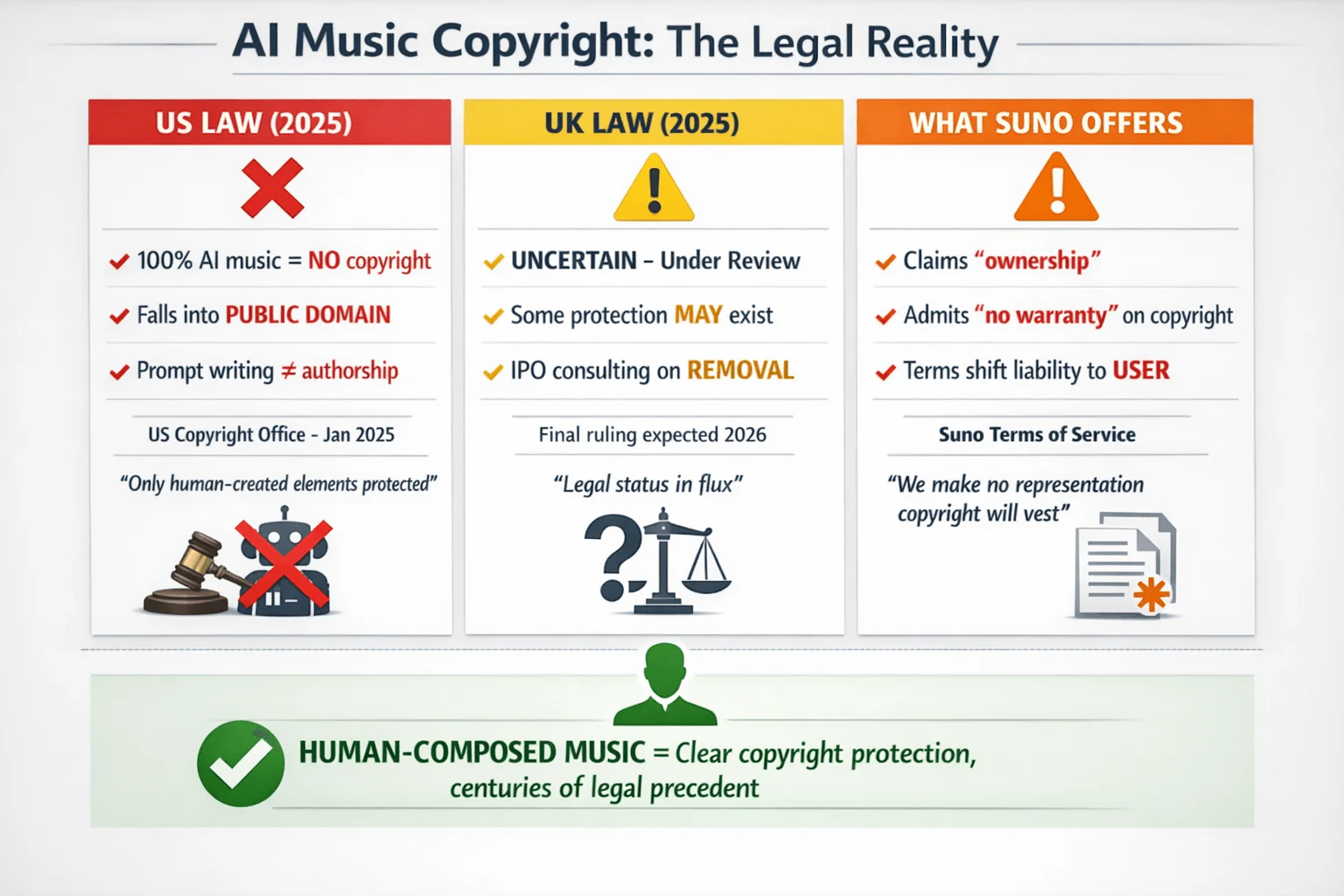
If you wrote lyrics and then prompted Suno to build music around them, you own the lyrics and only the lyrics. Human-written words are copyrightable; the generated audio underneath them, under current US Copyright Office guidance, is not. If you wrote actual songs — melody, chords, structure — and used Suno to produce and arrange them, you’re in a much stronger position, because the composition is yours and Suno was doing a producer’s job rather than a writer’s. That distinction is the whole ballgame, and it’s worth being honest with yourself about which one you did.
Either way, three practical things.
Document what you’ve got, now. Original lyric sheets, dates, any demos or voice memos, the prompts themselves. If you ever need to prove authorship — to register the work, to fight a claim, to license it — “I definitely wrote this” is a much weaker argument than a timestamped paper trail across 300 songs.
Be careful about promoting and distributing. Every major platform now requires AI disclosure through your distributor, and the EU’s rules on marking AI-generated audio become enforceable in August. Declare it accurately. Undisclosed AI is now the thing that gets releases pulled and accounts reviewed, and with a catalogue that size, one bad flag can jeopardise the lot. Also worth knowing: you almost certainly can’t register these with Content ID, and you’d be unwise to try.
Understand what you can’t stop. Where the music isn’t protected, you have no legal route to prevent someone else uploading it, distributing it, or claiming it. That’s not a hypothetical — it’s the single most common way people get burned here.
If these songs matter to you, the strongest move by some distance is to re-record the ones you care about most with real musicians, using the Suno versions as demos. Expensive and slow, yes. But it converts an unprotectable file into a work you actually own. Three hundred is a lot to be holding on uncertain ground.
Shane